AI made content faster. It also made the story easier to drift. MessageWorks is the layer between your positioning and revenue-generating content that ships across marketing, sales, and success.

Output per marketer
Fewer review iterations per asset under governed positioning
Off-draft assets shipping when positioning is codified vs. industry baseline
Lift in B2B email and ABM response rates
The challenge is no longer volume. It's whether every asset reflects the positioning your team agreed on. MessageWorks gives PMM, marketing, and sales one source of truth they pull from on every draft.
.svg)
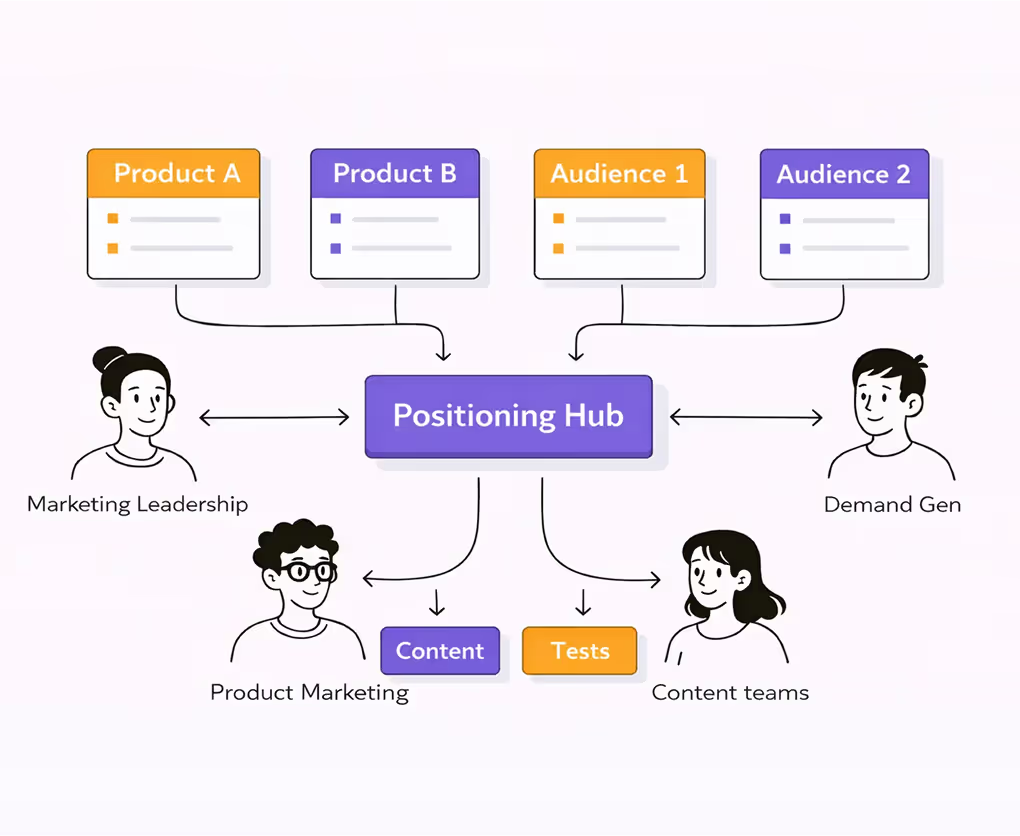
A live positioning hub markets, segments, personas, and value props all teams work from.
Briefs, drafts, and revisions that start on-positioning and stay there as PMM scales output.
Synthetic audiences pressure-test claims and angles in seconds, so PMM & content teams can refine before spend goes live.
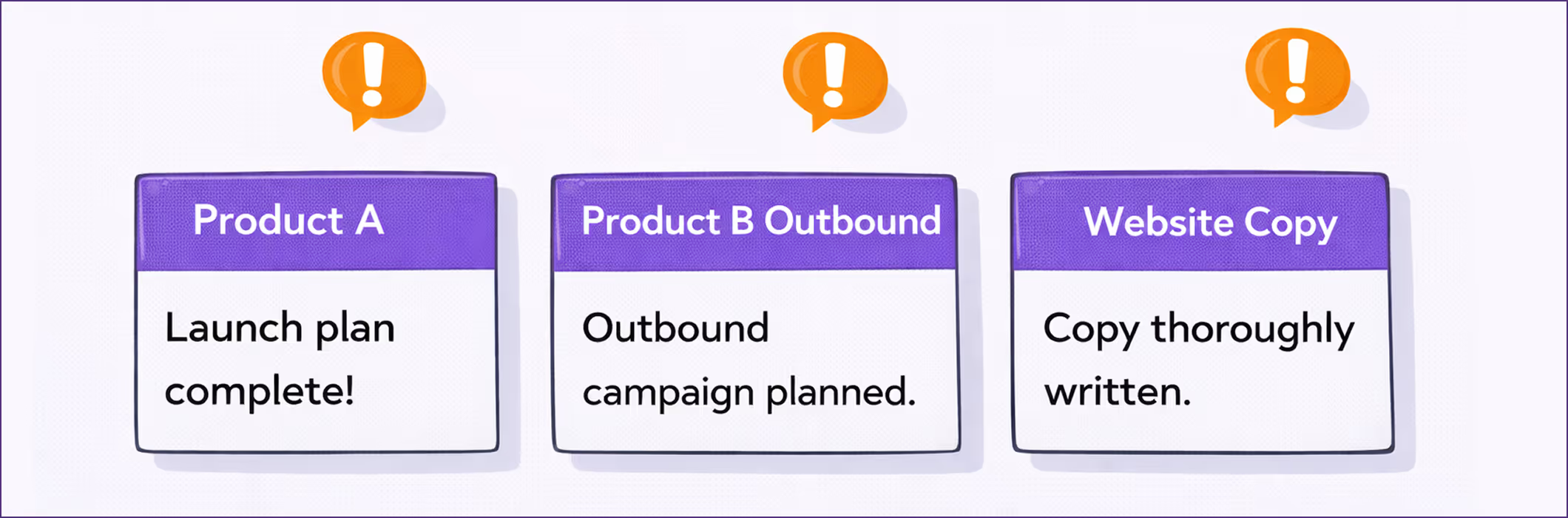
When the canonical narrative lives where work actually happens, the operating model shifts. PMM stops policing every draft. Sales stops improvising. Launches stop slipping while the messaging gets re-litigated in review.

Every AI-generated draft is checked against the approved positioning before it ships. Off-message language, deprecated claims, and competitor phrasing surface inside the workflow, not after launch.

Strategy moves. The story has to move with it. Updated positioning propagates into prompts, templates, and content systems immediately, so legacy claims stop showing up in outbound, on the website, and in sales decks weeks later.

Pressure-test claims, angles, and full assets against synthetic audiences grounded in your real segments and personas. PMM gets a fast read on what will land before campaign budget is committed and before sales is enabled.
Encode positioning once. Generate on-message at PMM scale. Pressure-test before launch.

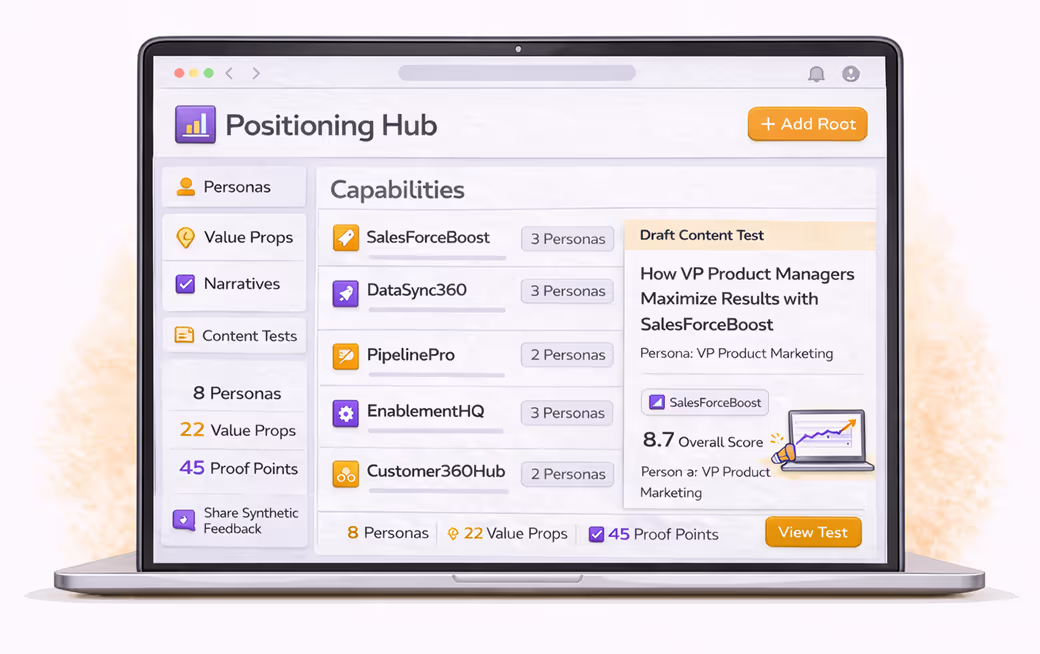
Markets, segments, personas, value props, and proof points get structured into a hub the team actually works from. PMM defines the story once, in a form every downstream tool can pull from.

Drafts start grounded in approved positioning instead of blank prompts. Marketing and sales generate persona-specific assets at the volume the calendar demands, while staying inside the messaging the leadership team agreed on.


Synthetic audiences read every important asset against the segments, personas, and value props you encoded upstream. PMM and leadership see how the story is likely to land before a campaign goes live, then refine with the evidence in hand.

A positioning operations platform treats your narrative as operational infrastructure: a living system that captures company-, segment-, and persona-level messaging in one governed place and makes it reusable downstream. Unlike standalone docs, it’s designed to enforce a Unified Positioning OS across teams - so launches, campaigns, and sales assets start from the same canonical story and reduce drift, rework, and opinion-driven debates.
Turn the founder’s story into a reusable system by translating it into a structured messaging architecture - who you serve, the problems you solve, why you win, and how product capabilities map to outcomes - then making that the central source everyone uses. MessageWorks supports this through Positioning Discovery (guided capture) and a Positioning Intelligence Hub, so the narrative becomes a Unified Positioning OS that teams can reuse for launches and content without constant founder interpretation.
Start with plain-language buyer reality: what your best-fit customers are trying to accomplish, what makes them struggle, and what outcomes they care about - then map your product capabilities to those outcomes as clear, persona-specific value propositions. MessageWorks is grounded in a job-to-be-done (JTBD) based approach (especially translating capabilities into persona value props) and captures the result in a Positioning Intelligence Hub, so teams can reuse consistent language without relying on abstract frameworks.
Alignment comes from having one governed messaging architecture that everyone can find, reuse, and update - so teams aren’t improvising from different decks and opinions. MessageWorks’ Unified Positioning OS (via the Positioning Intelligence Hub) is designed to be that source of truth, connecting segment/persona narratives to value pillars and product capabilities so web, email, and sales assets ladder up to one coherent story.
Messaging stays healthy when there’s a clear owner of the canonical narrative and a repeatable way to evolve it as products, markets, and segments change. MessageWorks is built around a governed Positioning Intelligence Hub - supporting the work of formalizing and governing messaging & positioning architecture - so updates are made to one source of truth that downstream teams can reliably reuse, rather than chasing the “latest deck.”
You reduce opinion-driven churn by grounding decisions in an agreed-upon messaging architecture and using structured, pre-launch evidence to evaluate drafts. MessageWorks supports this with a governed Positioning Intelligence Hub (so teams can reference canonical language and rationale) and Evidence-Led Message Optimization via Synthetic Focus Groups and content testing to surface what’s confusing or unconvincing for specific personas - before a debate becomes a rewrite spiral.
Setup in MessageWorks is designed to get you from scattered ideas and documents to a usable positioning system quickly using Positioning Discovery and the Positioning Intelligence Hub. That matters because small teams can’t afford long workshops or endless rewrites when launches or outbound need to move.
Yes - MessageWorks’ AI-Powered Content Generation produces channel-ready drafts (web, email, LinkedIn, etc.) that are grounded in your Unified Positioning OS: segment/persona narratives, value propositions, objections, and proof points. This matters because non-experts and distributed teams typically generate fast but off-strategy copy that senior PMMs or strategists must rewrite.
MessageWorks keeps AI-generated copy on-strategy by grounding generation in your Positioning Intelligence Hub - the canonical architecture for your segments, personas, value props, and proof points - rather than treating each prompt as an isolated request. This matters because generic AI tools default to bland, “me-too” messaging when context is thin.
Yes - MessageWorks is designed to support the objective of translating product capabilities into aligned, persona-specific value propositions. Using the Positioning Intelligence Hub as a governed “Unified Positioning OS,” teams can structure how capabilities roll up into role- and persona-specific outcomes, benefits, and proof points so product, marketing, demand gen, and sales start from the same canonical story and avoid drift.
Synthetic Audiences in MessageWorks are a way to predict how a defined buyer segment or persona is likely to respond to a message—by using large language models as expert forecasters of audience response, not as role-playing “pretend buyers.” Instead of producing a single opinion, Synthetic Audiences model distributions of reactions across a realistic audience, preserving disagreement, confusion, and partial resonance. They exist to give teams structured, repeatable, persona-grounded insight before messages reach real customers, where waiting for post-launch data is slow or impractical.
MessageWorks supports pre-launch message testing through Content Testing with AI-Generated Synthetic Focus Groups, aligning directly to the objective of de-risking and optimizing content before it reaches real audiences. Draft assets can be evaluated against your canonical messaging architecture in the Positioning Intelligence Hub and then stress-tested with synthetic persona reactions, producing prioritized recommendations to improve clarity, relevance, and persuasiveness before launch decisions are locked.
Yes - MessageWorks is built to help you stress-test positioning and key messages before high-stakes moments using Synthetic Focus Groups and AI content testing, aligned with the “Evidence-Led Message Optimization” pillar. You can compare alternative positioning angles or draft narratives against defined personas and your canonical positioning system to see where each version is likely to be confusing, unconvincing, or off-target, and use that feedback to choose and refine the direction.
Use this system when you need positioning to behave like operating infrastructure - codified in a Positioning Intelligence Hub and continuously reused for content generation and pre-launch testing - rather than a static deck or isolated copy project. It matters when launches, segments, or buying roles are multiplying and teams risk messaging drift, because the primary outcome is sustained alignment on canonical narratives across product, marketing, and sales.
Generic AI copy tools treat each draft as an isolated prompt, which often leads to inconsistent, “me-too” output when teams can’t provide full strategic context. This system is built around a Unified Positioning OS (via the Positioning Intelligence Hub) that encodes segment/persona value propositions and then powers AI-Powered Content Generation and Synthetic Focus Groups from the same governed source - so drafts can be generated and stress-tested against the official narrative.
The positioning your team built belongs in the workflow, not in a deck nobody opens. See how MessageWorks operationalizes it for B2B SaaS GTM teams.

.svg)

