MessageWorks captures your evolving pitch and turns it into a structured hub every AI tool, freelancer, and new hire draws from, so a lean team ships one sharp story while the pitch keeps changing.
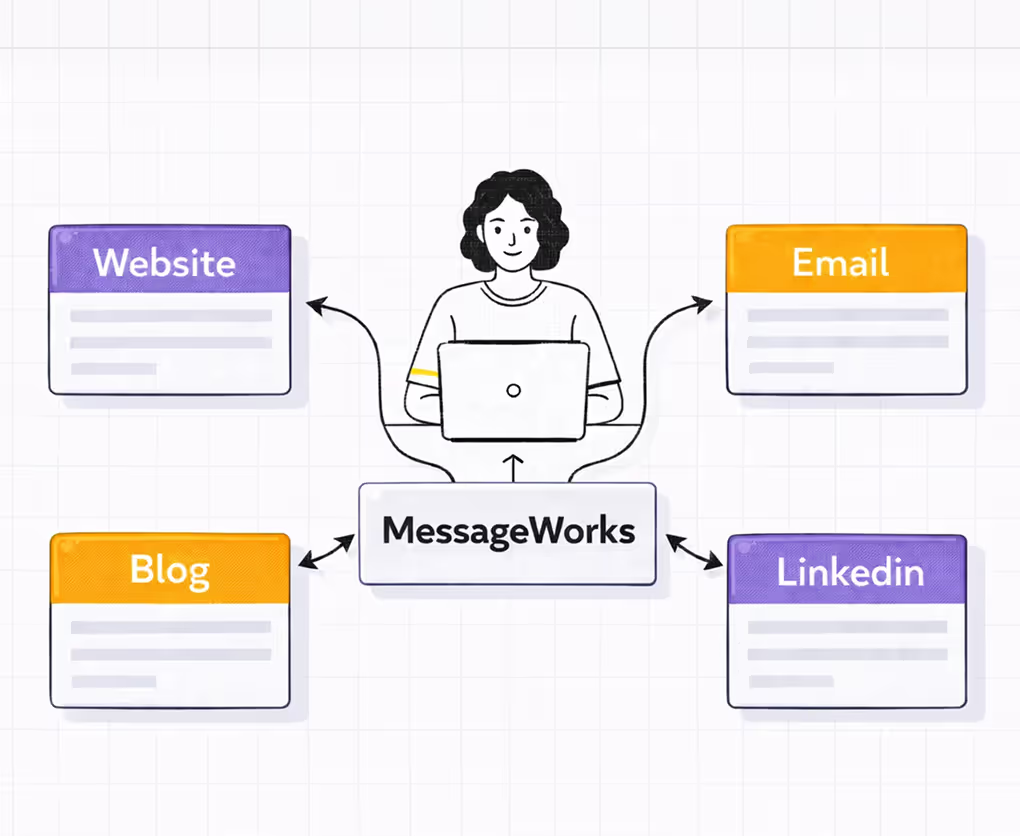

Encode it once. Every surface picks it up.
Drafts start from your story, not the model's defaults.
Test the website, deck, and outbound narrative first.
Founders rewrite the pitch after every investor call. AI tools generate generic SaaS copy that misses the actual problem you solve. Freelancers and first hires interpret the latest version differently. Each experiment runs without a clean way to roll learnings back into the next pitch.
.svg)
Every important message routes through the founder, who's already running the company.
AI tools generate copy generic enough to fit any SaaS, not the one you're actually building.
Untested launches waste time and money you don't have.

MessageWorks gives you a structured hub for the latest pitch, AI guardrails on every draft, and a fast read on which messages actually land with your ICP.

Encode the latest pitch, ICP, and value props in a structured hub every team member, freelancer, and AI tool draws from. When the pitch shifts, every downstream surface picks up the change.

Every draft, whether written by a freelancer, a first hire, or an AI tool, gets checked against the encoded pitch before it ships. Off-pitch language is flagged at generation, not after a campaign goes live.

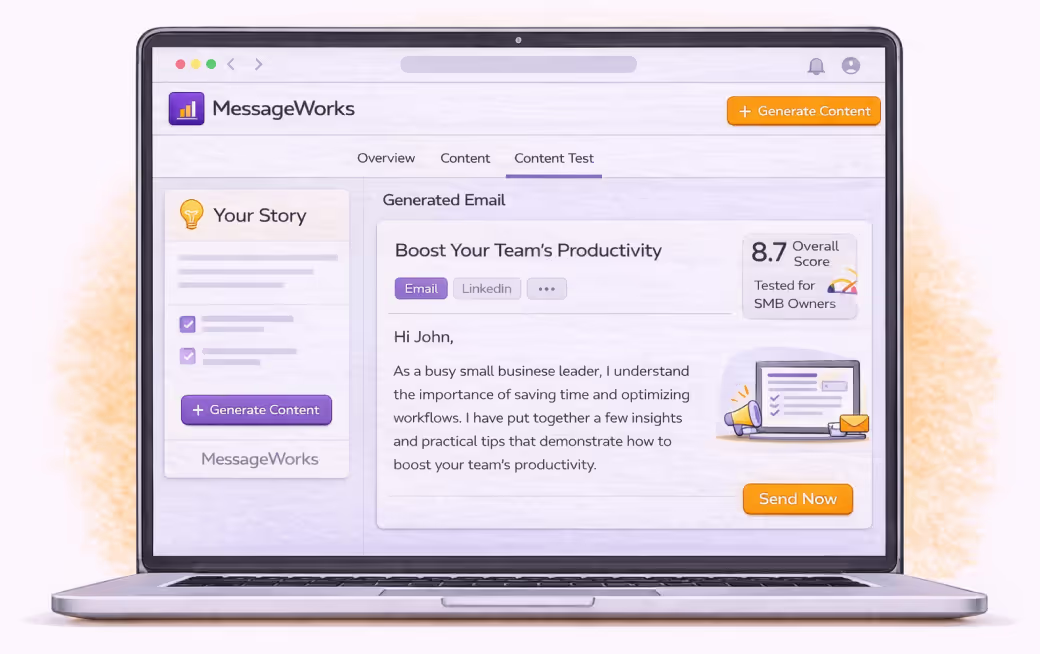
Test variants against synthetic audiences in under 60 seconds before sending the email or shipping the page. Roll learnings back into the pitch.
Encode the pitch in one structured hub. Generate AI drafts that start on-pitch. Test the high-stakes ones with synthetic audiences before you ship. Three steps the team runs every week, no founder edits required.
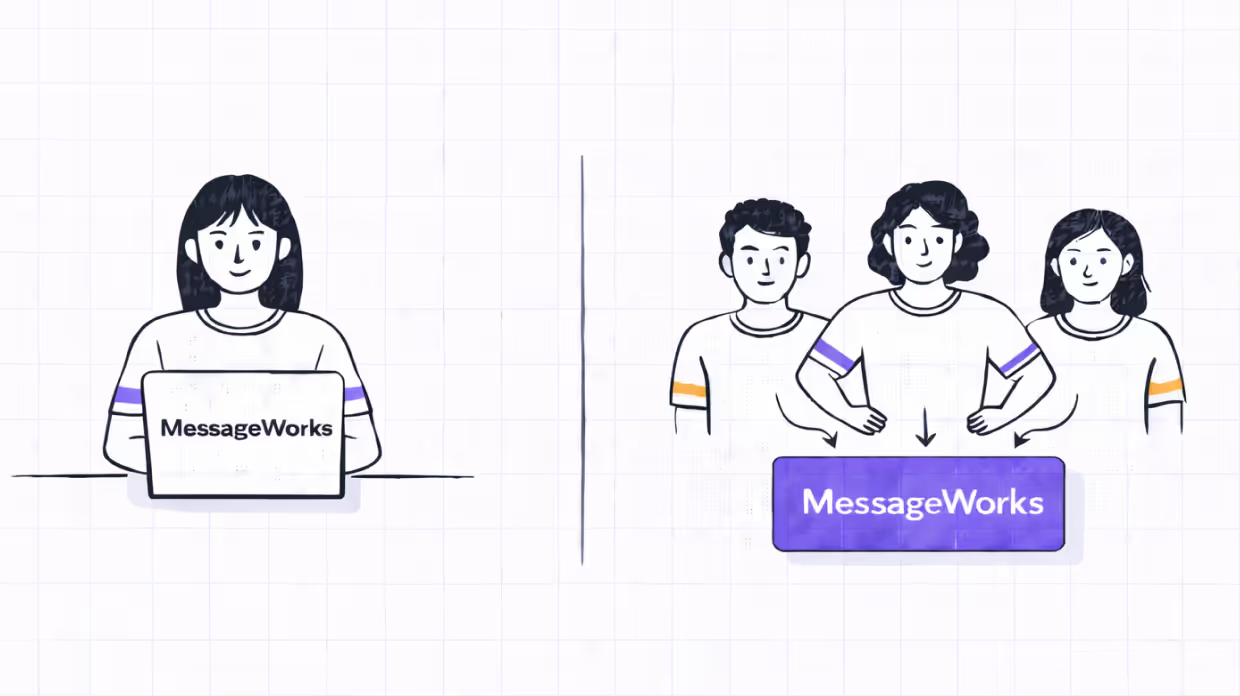

Founder updates flow into the hub. Every channel picks them up.
Drafts start on-pitch. Freelancers, agencies, and AI tools work from the same source.
Sanity-check the website, the deck, and the fundraise narrative before they ship.

A positioning operations platform treats your narrative as operational infrastructure: a living system that captures company-, segment-, and persona-level messaging in one governed place and makes it reusable downstream. Unlike standalone docs, it’s designed to enforce a Unified Positioning OS across teams - so launches, campaigns, and sales assets start from the same canonical story and reduce drift, rework, and opinion-driven debates.
Decks, docs, and spreadsheets usually become scattered “snapshots” of your story, which makes it hard to keep product, marketing, and sales consistent as you iterate. The MessageWorks approach centers on a Unified Positioning OS - a governed, reusable messaging system - so your core narrative, value pillars, and persona-specific value props are easier to apply across your website, emails, and decks without rebuilding from scratch each time.
Turn the founder’s story into a reusable system by translating it into a structured messaging architecture - who you serve, the problems you solve, why you win, and how product capabilities map to outcomes - then making that the central source everyone uses. MessageWorks supports this through Positioning Discovery (guided capture) and a Positioning Intelligence Hub, so the narrative becomes a Unified Positioning OS that teams can reuse for launches and content without constant founder interpretation.
Alignment comes from having one governed messaging architecture that everyone can find, reuse, and update - so teams aren’t improvising from different decks and opinions. MessageWorks’ Unified Positioning OS (via the Positioning Intelligence Hub) is designed to be that source of truth, connecting segment/persona narratives to value pillars and product capabilities so web, email, and sales assets ladder up to one coherent story.
Messaging stays healthy when there’s a clear owner of the canonical narrative and a repeatable way to evolve it as products, markets, and segments change. MessageWorks is built around a governed Positioning Intelligence Hub - supporting the work of formalizing and governing messaging & positioning architecture - so updates are made to one source of truth that downstream teams can reliably reuse, rather than chasing the “latest deck.”
MessageWorks prevents drift by anchoring all content work to a Positioning Intelligence Hub - a governed, hierarchical messaging architecture that defines what you say by segment and persona, with canonical language and constraints. This matters because as contributors multiply, teams otherwise default to improvising from scattered decks and “gut feel.” The primary outcome is consistent, persona-specific messaging across channels, with less rework and fewer debates about what’s “on message.”
Setup in MessageWorks is designed to get you from scattered ideas and documents to a usable positioning system quickly using Positioning Discovery and the Positioning Intelligence Hub. That matters because small teams can’t afford long workshops or endless rewrites when launches or outbound need to move. The primary outcome is a clear, governed narrative you can immediately use to generate on-message first drafts for web and email - then edit and ship with confidence.
Yes - MessageWorks’ AI-Powered Content Generation produces channel-ready drafts (web, email, LinkedIn, etc.) that are grounded in your Unified Positioning OS: segment/persona narratives, value propositions, objections, and proof points. This matters because non-experts and distributed teams typically generate fast but off-strategy copy that senior PMMs or strategists must rewrite. The primary outcome is higher-throughput content creation where experts refine and approve instead of reconstructing the narrative from scratch.
MessageWorks keeps AI-generated copy on-strategy by grounding generation in your Positioning Intelligence Hub - the canonical architecture for your segments, personas, value props, and proof points - rather than treating each prompt as an isolated request. This matters because generic AI tools default to bland, “me-too” messaging when context is thin. The primary outcome is first drafts that reflect what you actually want to say, to the right buyer, with less drift as you scale content.
Yes - MessageWorks is designed to support the objective of translating product capabilities into aligned, persona-specific value propositions. Using the Positioning Intelligence Hub as a governed “Unified Positioning OS,” teams can structure how capabilities roll up into role- and persona-specific outcomes, benefits, and proof points so product, marketing, demand gen, and sales start from the same canonical story and avoid drift.
Synthetic Audiences in MessageWorks are a way to predict how a defined buyer segment or persona is likely to respond to a message—by using large language models as expert forecasters of audience response, not as role-playing “pretend buyers.” Instead of producing a single opinion, Synthetic Audiences model distributions of reactions across a realistic audience, preserving disagreement, confusion, and partial resonance. They exist to give teams structured, repeatable, persona-grounded insight before messages reach real customers, where waiting for post-launch data is slow or impractical.
Synthetic testing is a better fit when you need fast, pre-launch feedback on whether a message is likely to resonate - and why - especially when you don’t have the time, budget, or traffic for traditional research or A/B tests. It supports the JTBD of de-risking and optimizing content before it reaches real audiences by simulating persona reactions and surfacing concrete areas of confusion or weak persuasion, so you can iterate before a high-stakes moment.
Yes - MessageWorks is built to help you stress-test positioning and key messages before high-stakes moments using Synthetic Focus Groups and AI content testing, aligned with the “Evidence-Led Message Optimization” pillar. You can compare alternative positioning angles or draft narratives against defined personas and your canonical positioning system to see where each version is likely to be confusing, unconvincing, or off-target, and use that feedback to choose and refine the direction.
Because MessageWorks combines a Unified Positioning OS, On-Brand Content at Scale, and Evidence-Led Message Optimization in one system, ROI is typically framed as fewer rewrites and review cycles, faster launch/campaign execution, and less reliance on one-off consultant artifacts or slow research. It matters because it supports a clearer decision on “what we say, to whom, and why,” while improving confidence before high-stakes messaging goes live.
Generic AI copy tools treat each draft as an isolated prompt, which often leads to inconsistent, “me-too” output when teams can’t provide full strategic context. This system is built around a Unified Positioning OS (via the Positioning Intelligence Hub) that encodes segment/persona value propositions and then powers AI-Powered Content Generation and Synthetic Focus Groups from the same governed source - so drafts can be generated and stress-tested against the official narrative.
Lock in the pitch, run it everywhere, and pressure-test what matters before launch. Without slowing down or pulling the founder back into edits.

.svg)
